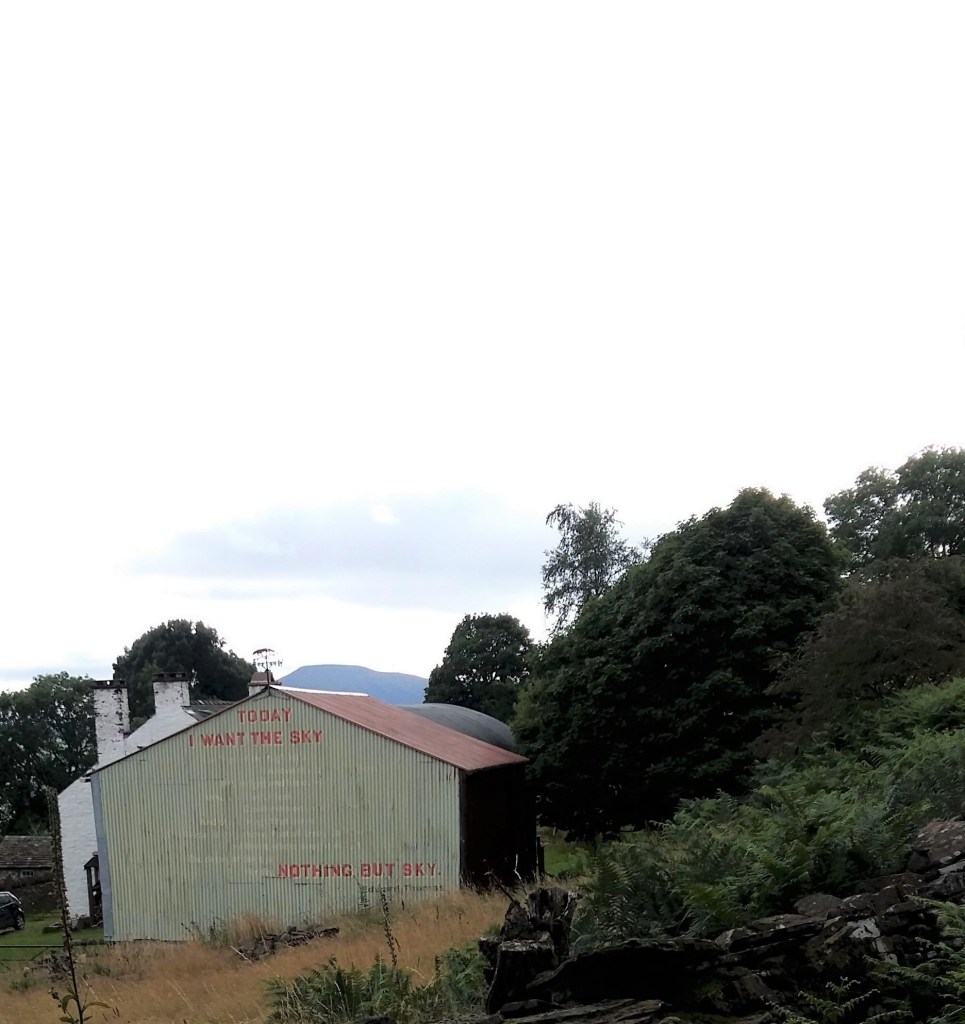
The Space Between

I lie on my back and watch the clouds, squinting at the glare – blue sneaks through and the sun catches me.


Clouds like thoughts passing

Like thoughts there are layers – the lower layers of cloud pass more quickly, trotting past while the larger, mature clouds above seem to sit and ponder. Yet when I close my eyes for a few moments and open them again, the scene has changed beyond recognition. A blue sky with scraps of wool and tiny swirls of white, lies above me – where did all those clouds go? Where did all those thoughts go?

And now it’s hot. I sit up and see a tangle of butterflies hovering and flitting over a lavender bush nearby.

They drop and twirl
    float and catch
       those butterflies like my thoughts
          drawn by the sweetness of a spire of lavender

then distracted by another,
     lifted by the breeze,
          spinning in the light.    

All this air around us

All this space that we don’t account for because we experience it as having no colour, no solidity.

We walk through,

We see through;

Without that air, that space, we’d be locked in, locked up, trapped and dead.

I feel so gloriously grateful for this space between, that I cannot touch, cannot see, cannot smell, yet it gives me life.

What about the space where thoughts appear? The great sky of awareness?

The thoughts flit, ponder, twirl and hover, or like clouds, bring heaviness or rain. Sometimes they wounds us,but they do all pass. Like the butterflies and the lavender bush and the bugs landing on my arms they give colour and weight and interest but it’s all the space in between and around that lets me see them. It is the space that allows me to respond.

Quiet for the mind is like sky to the clouds – Give it plenty – glorious, rolling miles of it, tonnes of cubic metres of it.

Give those thoughts space to roll and skitter, 
    thunder and threaten, 
        gather and scatter, or 
             disappear leaving a fresh brightness.  

They are always gathering and scattering, 
     heavy clouds passing, blue sky piercing 
        and behind them all is always 

Awareness, clear and wide, beautiful and boundless.

Lie on the grass. Look up. Watch the clouds pass. See all the space between and know that it is not the space that is ‘in between’ but us, the clouds, the butterflies, the lavender bush that intersperse this space. The space was there before us, will be there after us, encompasses all.

Mary Oliver, I bow to your poem of the One World.


Poem of the One World, by Mary Oliver (from ‘A Thousand Mornings’)

This morning
The beautiful white heron
Was floating along above the water

And then into the sky of this
The one world
We all belong to

Where everything
Sooner or later
Is part of everything else.

Which thought made me feel
For a little while
Quite beautiful myself.

‘You do not have to be good’ – a tribute to Mary Oliver, poet

‘You must not ever give anyone else the responsibility for your life’


Mary Oliver, U S poet, Pulitzer prize winner and inspiring human being, died on 17th January aged 83.  One of her most famous poems, “Wild Geese” begins:

‘You do not have to be good.

You do not have to walk on your knees

for a hundred miles through the desert repenting.’


You do not have to be good – Every time I read that sentence, my shoulders drop in relief.  For over 12 years now, my intention has been to become more ‘real,’ rather than ‘good’ and for the last 5 years the poems of Mary Oliver have kept me company.  Like many others, I’ve been brought up to be ‘good’ and not to attend to my needs or pay attention to what I want in life.  As a result, I would not ask directly for what I wanted and often didn’t even know what I wanted.  Instead my tendency was towards the ‘passive aggressive’ approach: ‘I won’t tell you what I need but I’ll make it clear how disappointed I am that you didn’t work it out through ESP and do it anyway.’

But I’m changing!

Mary Oliver’s poem, ‘The Journey’ is that call to listen to yourself.  It begins:

‘One day you finally knew
what you had to do, and began,
though the voices around you
kept shouting
their bad advice —
though the whole house
began to tremble
and you felt the old tug
at your ankles.
“Mend my life!”
each voice cried.
But you didn’t stop.


You knew what you had to do…’


For some of us the bad advice, the voices calling, are mostly external and for some its all inside our heads but those voices, that advice can be so strong, so undermining of our confidence in our own voice, our own experience.

Its painful recognising our patterns of response and changing them but it is also liberating and delicious when we realise we are not trapped!

Mary Oliver was a gay woman who found her life partner, Molly Malone Cooke in 1964,  ‘I took one look and fell, hook and tumble’.  They lived together for over 40 years before Molly died in 2005.  After she died, in ‘A Pretty Song’ Mary writes ‘From the complications of loving you, I think there is no end or return.’

Mary Oliver never explicitly wrote about this side of her life but I would recommend  a read from  https://lithub.com/on-the-overlooked-eroticism-of-mary-oliver/ written by Jeanna Kadlec.  Jeanna remarks how Mary Oliver’s poems gave her hope as a young gay woman:

‘For me, someone who grew up in the evangelical church, the experience of reading “Wild Geese” has often been about receiving permission to desire within my own body: I do not have to be good; I do not have to repent.

‘You only have to let the soft animal of your body love what it loves.’

Whatever our faith/non-faith position is we all have an idea of what ‘good’ is that matters to us. It might be being good ‘morally’ or good in relationships or ‘following God”, or changing the world for the better in one way or another.  But unless we begin by seeking authenticity, the ‘goodness’ lark will either whiplash back on us (what a hypocrite/lousy mother/shit friend I am, etc|)  or the whip will land on others (they ‘should’ be…) .  So instead when I remember, I practice being real, bringing awareness and acceptance of myself as I actually am, having compassion for this human being here at this moment. It’s a life’s work.

For Mary Oliver, her work was to love and be amazed by this world.  It was mostly the natural world but not always.  In the poem ‘Singapore,’  Mary Oliver finds herself in the airport toilet when she notices a woman cleaning ashtrays in the toilet bowl:

‘Disgust argued in my stomach

And I felt in my pocket, for my ticket.

A poem should always have birds in it….’

But she stays and then,

‘When the woman turned I could not answer her face.

Her beauty and embarrassment struggled together and

neither could win.

She smiled and I smiled.  What kind of nonsense is this?

Everyone needs a job.’

And later


‘I don’t doubt for a moment that she loves her life.

And I want her to rise up from the crust and the slop

And fly down the river.

This probably won’t happen.

But maybe it will.

If the world were only pain and logic, who would want it?

Of course, it isn’t.


Neither do I mean anything miraculous, but only

The light that can shine out of a life.  I mean

The way she unfolded and refolded the blue cloth,

The way her smile was only for my sake; I mean,

The way this poem is filled with trees and birds.’


I want to finish with one of Mary Oliver’s poems in its entirety.  It is called “When I am among the Trees”.  Trees don’t worry about being ‘good’,  they simply ‘are’ what they are, with their roots deep down in the soil connecting with this world and their branches and leaves reaching out to the light.  If you haven’t already done so, try standing against a tree for 20 minutes, feeling the bark supporting your back, looking up through rich layers of leaves or perhaps bare branches sharp against the sky, smelling the air, listening to sounds, breathing. Its a gift.


When I am among the trees,
especially the willows and the honey locust,
equally the beech, the oaks and the pines,
they give off such hints of gladness.
I would almost say that they save me, and daily.

I am so distant from the hope of myself,
in which I have goodness, and discernment,
and never hurry through the world
but walk slowly, and bow often.

Around me the trees stir in their leaves
and call out, “Stay awhile.”
The light flows from their branches.

And they call again, “It’s simple,” they say,
“and you too have come
into the world to do this, to go easy, to be filled
with light, and to shine.”


Thank you, Mary Oliver, for the light you have shone on my life.